
If you’re setting up a new saltwater pool or switching your current one from chlorine, figuring out how many bags of salt for pool startup is key to getting things right. As a home pool owner with a typical backyard setup—like a 10,000 to 15,000 gallon pool—you want straightforward advice. This guide helps DIY folks like you calculate salt needs, add it safely, and keep your water balanced1. We’ll break it down step by step, using common 40-pound bags of pool-grade salt for easy shopping at local stores in places like the US, Canada, UK, or Australia.
Why Switch to a Saltwater Pool?
Saltwater pools use a saltwater chlorinator setup to make chlorine from salt, which means softer water and less harsh chemicals. Many homeowners choose this for easier upkeep and fewer eye irritations. If you’re starting fresh with a new pool fill or converting an old chlorine system, salt is the first big addition. But get it wrong, and you risk low chlorine output or equipment damage. Don’t worry—we’ll cover the basics to make it simple.
Understanding Pool Salt Basics
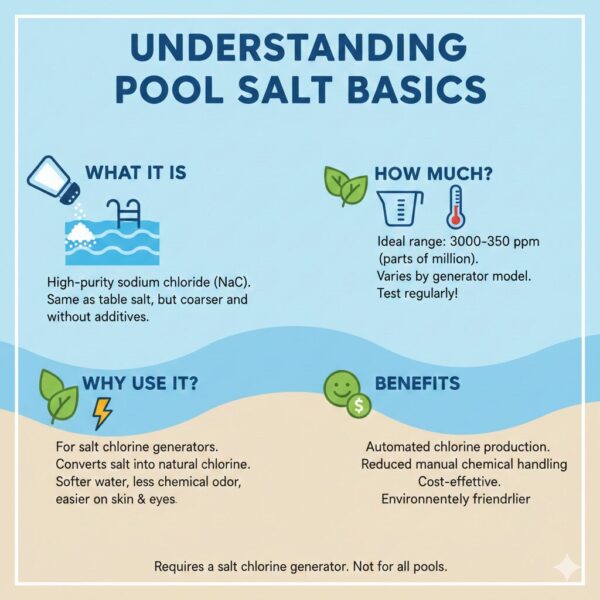
Salt in pools isn’t like table salt. Use pure sodium chloride without additives to avoid stains. Most systems aim for ideal salinity for saltwater pool around 3,200 parts per million (ppm). This level lets your generator produce enough chlorine without overworking. Too low (under 2,700 ppm), and chlorine drops. Too high (over 4,500 ppm), and it corrodes metals or shortens your salt cell’s life.
For startup, test your current salt level first. New fills start at 0 ppm, while conversions might have some leftover from past treatments. Always use a reliable tester—like strips or a digital kit—for accuracy.
How to Calculate Salt Needed for Your Pool
You don’t need fancy math skills. Start by measuring your pool volume in gallons. For a rectangular pool, it’s length times width times average depth times 7.5. Round pools? Use diameter squared times average depth times 5.9.
Next, decide your target: 3,200 ppm. The formula for pounds of salt is: Pool gallons × 8.35 × (Target ppm – Current ppm) / 1,000,000.
For example, a 10,000-gallon pool at 0 ppm needs 10,000 × 8.35 × 3,200 / 1,000,000 = about 267 pounds. That’s roughly six to seven 40-pound bags.
Use a pool salt calculator online for quick results, but double-check with manual tests. This keeps things precise and avoids over-salting a pool.
How Many Bags of Salt for Pool Startup by Pool Size
Let’s get practical. Most backyard pools fall in the 10,000 to 15,000 gallon range. Here’s a breakdown based on starting from 0 ppm to hit 3,200 ppm:
- For a 10,000-gallon pool: You need around 267 pounds. That’s about six to seven 40 lb pool salt bags. Add five first, test, then add more if needed.
- For a 12,000-gallon pool: Aim for 320 pounds, or eight bags. If converting with 1,000 ppm already, drop to five bags (200 pounds).
- For a 15,000-gallon pool: Expect 400 pounds, which is ten bags. This covers typical setups without wasting salt.
These estimates use pool salt dosage guidelines from experts. Remember, salt doesn’t vanish—it stays unless you drain water. For yearly startups, you might only need one or two bags to top up after winter dilution.
If your pool is smaller or larger, scale it. A pool salinity chart can help: Every 8 pounds raises 10,000 gallons by 100 ppm. So for low salinity fixes, add bit by bit.
Step-by-Step Saltwater Pool Startup Guide
Ready to add salt? Follow these steps for a safe launch:
- Test and balance water chemistry: Before salt, check pH (7.2-7.8), alkalinity (80-120 ppm), and calcium hardness (200-400 ppm). Adjust with chemicals if off. This prevents scaling or corrosion.
- Gather supplies: Buy pool-grade salt in 40-pound bags—pure, non-iodized, no anti-caking agents. You’ll also need a tester for testing pool salt levels.
- Turn off the generator: Keep your pump running for circulation, but switch off the saltwater generator to avoid errors.
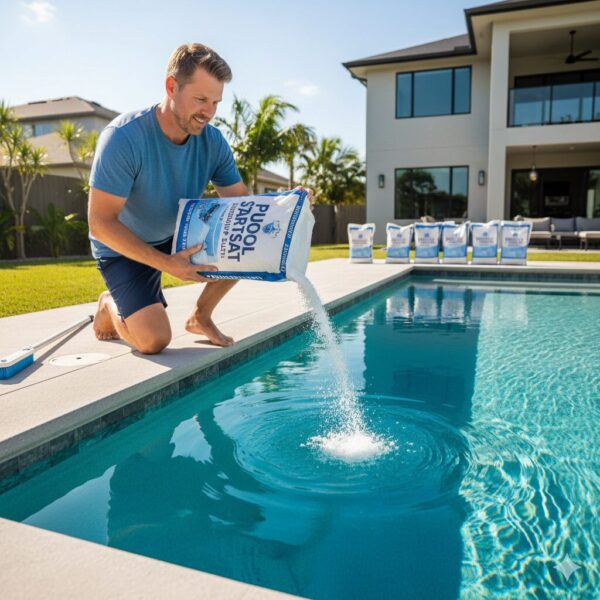
- Add the salt: Pour around the pool’s edge in the shallow end. Spread evenly—don’t dump in one spot. For big amounts, add in batches: one or two bags, brush to dissolve, wait 4-6 hours, then test.
- Dissolve and circulate: Run the pump 24 hours. Salt takes 10-30 minutes to break down if fine-grained, but full mixing needs time. Brush any piles to speed it up.
- Retest and adjust: Use your kit to check levels. If low, add more. Aim for that sweet 3,200 ppm.
- Start the system: Once balanced, turn on the generator. Shock the pool with chlorine if water is cloudy.
This step-by-step saltwater pool startup instructions works for new fills or conversions. It takes 24-48 hours for everything to settle.
Adding Salt to Pool: Best Practices
How to add pool salt without damaging surfaces? Always broadcast it—never pour into skimmers or filters. Use a brush to move it around. If you’re worried about clumping, pre-dissolve in buckets of pool water first.
For how long does it take for pool salt to dissolve, expect quick results with good circulation. Pool pump circulation for dissolving salt is crucial—run at high speed.
Avoid saltwater pool startup mistakes to avoid like over-adding without testing. If you go too high, drain some water and refill. Better to under-add and top up.
When buying online, watch for scams. Check resources on spotting fraud, like this guide on protecting your phone number online or spotting phone scams.
Converting a Chlorine Pool to Saltwater
Switching systems? Drain if needed, but often you can add salt directly. Test existing levels—chlorine pools might have 500-1,000 ppm from stabilizers.
Follow the same calculation: For a 10,000-gallon pool at 500 ppm, you need about 225 pounds (five to six bags). Install your saltwater chlorinator setup after balancing.
How to convert a chlorine pool into a saltwater pool takes a weekend. Clean equipment, add salt, and monitor for a week.
Maintaining Salt Levels After Startup
Once set, saltwater pool maintenance is easy. Test monthly. Losses come from splash-out, rain, or backwashing—add one bag yearly for most pools.
Watch for pool chemistry for saltwater systems: Keep pH stable to avoid cell scaling. Clean your salt cell every few months.
If levels drop, use how to raise pool salt levels tips: Add small amounts and retest.
For troubleshooting, like low chlorine, check salinity first. Saltwater pool troubleshooting often points to dirty cells or imbalanced water.
Tools and Recommendations
Get saltwater generator recommendations like Hayward or Pentair for reliability. Pair with a digital tester for ppm accuracy.
For volume, use pool volume measurement apps if unsure.
Convert gallons to salt conversion easily with charts: 40 pounds boosts 10,000 gallons by 480 ppm.
Common Questions on Pool Salt
Here are quick answers to boost your confidence:
How much pool salt to add for a 10,000 gallon pool?
About 267 pounds from scratch.
How many 40lb bags of salt do I need to start a saltwater pool?
Six to seven for 10,000 gallons.
How much salt do I need if my pool has low salinity?
Calculate the difference—e.g., from 2,000 to 3,200 ppm in 10,000 gallons needs 100 pounds (two to three bags).
How to calculate salt needed for pool startup?
Use the formula above or a free pool salt calculator.
What type of pool salt to use for saltwater generators?
Pure NaCl, pool-grade only.
Pool startup salt levels?
Target 3,200 ppm.
Pool salt ppm levels?
2,700-3,400 ideal.
Startup chemicals for saltwater pools?
Balance pH, alkalinity, then salt, and shock last.
Salt concentration for chlorine production?
Around 3,200 ppm for best output.
Safety and Cost Tips
Salt is cheap—bags cost $5-10 each in Tier 1 spots like the US. Buy in bulk but store dry.
Safety first: Wear gloves when handling, and keep kids/pets away during addition.
If ordering supplies, avoid shady calls. Learn about unknown numbers like 8443307185 or 1-626-572-3977 to stay safe.
In Conclusion
Starting your saltwater pool boils down to knowing how many bags of salt for pool startup—typically five to ten 40-pound bags for medium pools, based on your gallons and tests. Balance water first, add gradually, and test often for success. This setup gives you clear, soft water with less hassle year-round. With these tips, you’ll avoid common pitfalls and enjoy your pool soone2r.
What size is your pool, and are you starting new or converting? Share in the comments for more tailored advice!
References
- Reddit Pools Thread: Adding Salt to Pool – User tips on batch adding and dissolution for real-world conversions. ↩︎
- Swim University: How Much Pool Salt – Detailed calculations and bag estimates for startup. ↩︎